Since the first days of mankind, humans have been locked in a constant struggle against one, inescapable, permanent thing. Death. This battle has become known as… Survival.
A car crash, an active shooter, an earthquake. These are all examples of a Modern Survival situation. Modern Survival is a term I first heard from Mike Glover, of Fieldcraft Survival, and there’s not really one definitive explanation for what “Modern Survival” is. A lot of my decisions and priorities have been strongly influenced by his thoughts on survival, as well as the thoughts of others like him. This post is going to be my best method of explaining the concept, but it is ultimately that: My best method. I’m going to use a tier based concept, starting with the most basic of basic.
Tier One in Modern Survival is Bushcraft. Ultimately, the concept of survival is founded on the old methods, the most primal of survival skills. We call this bushcraft, or primitive living, and it’s a very strong foundation for Modern Survival. These skills hold a strong value in applications like staying warm when your car has broken down in the middle of nowhere, on a cold night. Or perhaps, as has happened recently in Hawaii, you get lost hiking, and are stranded for weeks on end. With a simple knowledge of bushcraft skills, you can make a reasonable shelter, and prevent exposure. Ultimately, bushcraft is reliant on the most simple of tools, and a lot can be accomplished using only your knowledge. This is why I consider it the foundation, for everything else to come.
But the concept of Modern Survival is only founded on the basics. After all, in an urban environment, it’s not about manipulating woodland assets, but rather the more modern assets that civilization provides us. For Tier 2, I consider my E.D.C, or Every Day Carry. The concept of EDC is actually pretty simple: Keep things on your person every day, that can facilitate survival and quality of life. You can take this concept as far as you want: I carry a knife, a flashlight, a tourniquet and a spare battery for my phone. In addition to this, I carry a gun when I’m not in the workplace, where legal, and a spare magazine.
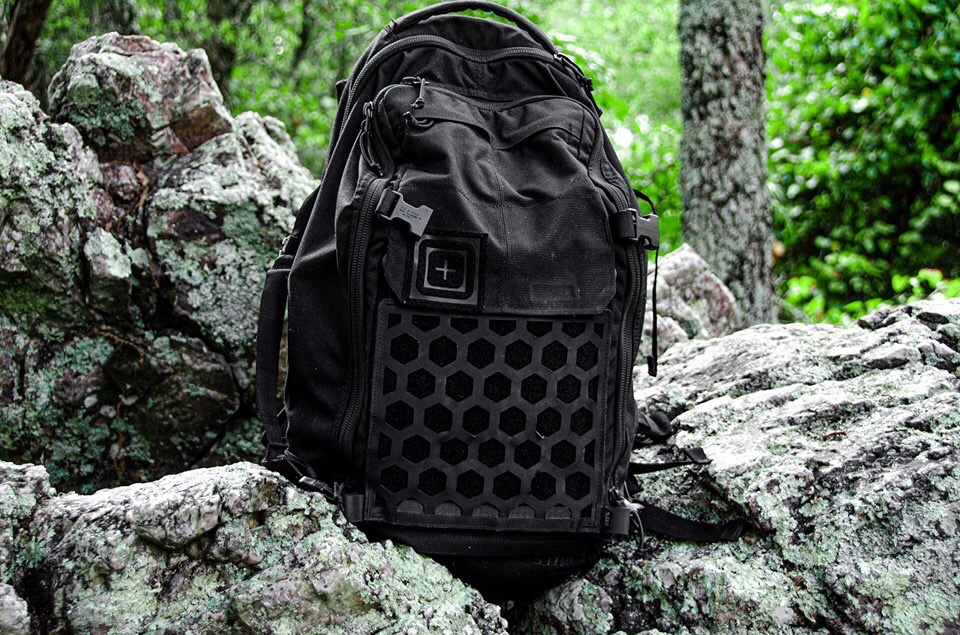
Tier Three will be your bag. It’s not always with you, but man, your bag can be pretty dang useful. I typically keep additional equipment in my bag, including a fixed blade knife, a more extensive medical kit, pens, a map of my local area, and pretty much anything I can stuff in that might be useful. The thing about your bag is that you can’t always have it with you, but you can keep it close a lot of times. It’s going to tie in to Tier Four pretty quickly, so keep reading for that. The most important thing is that you don’t fill your bag too full. You need to be able to move with your bag, and it needs to not be miserable. Period. If running sucks, and hiking sucks, and walking sucks, you’re probably doing it wrong.
Tier Four is going to be your car. Tier One through Three all fit in it, and it is a huge asset in the survival game. You DON’T need an insanely kitted out vehicle to facilitate survival in a disaster. A lot of times, your vehicle only needs a few things: To carry you, your gear, and to surmount obstacles. Whether you’re planning to get off road, or stick to the city streets, some simple things can be done to facilitate the greater goal of Modern Survival. My primary emphasis is on medical kits. A lot of times, you can’t take everything you need for an emergency into places like stores, and after all, who would? But in a disaster, your pocket medical kit may only be a stopgap measure, and you may need more supplies. Stabilizing yourself or your family member, and then getting to the supplies in your car could be the difference between life and death.
The Fifth and final Tier is going to be your home. Home is where you have to decide how far you’re going to take this. With my home, I plan to install steel frame security doors, and other simple improvements to keep potential intruders at bay. Some would install storage, collect food, ammunition, tools, and more. Others may try and install a solar panel grid, or a water treatment tank. I think the most important things to consider are how well your home will stand up to the disasters you are concerned with, as well as the people in your area; Modern Survival, to my mind, covers the most basic of disasters. Man made disasters. The people kind of disasters.
So ultimately, Modern Survival is a blend of the old and the new. It’s unlimited in the directions you can go with it, and can help aid in casting out fear. It can be ambiguous, at times, but that’s okay, because that opens you to new avenues of creativity in your journey. It helps you act with wisdom in the face of fear, and can prepare you to behave courageously. And sometimes, that little push is all you need to do amazing things. I may never experience a mass casualty event in my lifetime, and honestly, that’s perfectly fine by me. But I truly believe that with my foundation of knowledge, I would know how to react, and move according to that foundation. Perhaps a car breakdown wouldn’t be life threatening to me, but I can certainly save myself some discomfort, simply by tossing a blanket and some hand warmers in my car. So for those of you who take the time to read this, and for those of you who might be considering that first step, this has been my take on Modern Survival.
 modernsurvivalarkansas.com